Consider Again Fully Developed Couette Flow Flow Between Two Infinite Parallel
Open Journal of Fluid Dynamics
Vol.2 No.four(2012), Article ID:25400,four pages DOI:10.4236/ojfd.2012.24011
Estrus Transfer with Viscous Dissipation in Couette-Poiseuille Flow nether Asymmetric Wall Heat Fluxes
1Faculty of Engineering, Multimedia Academy, Cyberjaya, Malaysia
iiSchool of Mechanical & Aerospace Engineering, Nanyang Technological Academy, Singapore Urban center, Singapore
3Faculty of Engineering science & Technology, Multimedia University, Jalan Ayer Keroh Lama, Melaka, Malaysia
Email: franciscasheela@hotmail.com
Received June 29, 2012; revised August 5, 2012; accepted August 13, 2012
Keywords: Viscous Dissipation; Couette-Poiseuille Period; Newtonian Fluid; Nusselt Number; Brinkman Number; Constant Oestrus-Flux
Abstract
Analytical solutions of temperature distributions and the Nusselt numbers in forced convection are reported for flow through infinitely long parallel plates, where the upper plate moves in the flow direction with abiding velocity and the lower plate is kept stationary. The flow is causeless to exist laminar, both hydro-dynamically and thermally fully adult, taking into account the event of viscous dissipation of the flowing fluid. Both the plates existence kept at specified and at different constant oestrus fluxes are considered as thermal boundary weather condition. The solutions obtained from energy equation are in terms of Brinkman number, dimensionless velocity and heat flux ratio. These parameters greatly influence and give consummate understanding on heat transfer rates that has potentials for designing and analyzing free energy equipment and processes.
1. Introduction
Period of Newtonian fluids through various channels is of applied importance and oestrus transfer is dependent on menstruum conditions such as flow geometry and physical backdrop. Investigations in rut transfer behavior through various channels showed that the effect of viscous dissipation cannot exist neglected for some applications, such as flow through micro-channels, small-scale conduits and extrusion at loftier speeds. The thermal development of forced convection through infinitely long fixed parallel plates, both plates having specified constant heat flux had been investigated [1-v]. For the aforementioned but filled by a saturated porous medium, oestrus transfer analysis was done where the walls were kept at compatible wall temperature with the upshot of mucilaginous dissipation and axial conduction taken into account [6]. In [7], it was concluded that in a porous medium, the absence of gluey dissipation outcome can have slap-up impact. For the horizontal double passage channel, uniform wall temperature with asymmetric and symmetric heating and the outcome of viscous dissipation had been investigated [eight].
For the pipage flow, where the walls are kept either at constant rut flux or constant wall temperature, analytical solution is obtained for both hydro-dynamically and thermally fully adult and thermally developing Newtonian fluid flow, considering the result of viscous dissipation [nine,10].
Analytical solution with the effect of viscid dissipation was derived for Couette-Poiseuille period of nonlinear visco-elastic fluids and with the simplified Phan-ThienTanner fluid between parallel plates, with stationary plate subjected to abiding oestrus flux and the other plate moving with constant velocity but insulated [11-13]. Numerical solution of fully adult laminar heat transfer of ability-law non-Newtonian fluids in plane Couette menses, with constant oestrus flux at ane wall with other wall insulated had been investigated [14] and analytical solution was derived for Newtonian fluid [fifteen].
A numerical investigation had been washed to notice the heat transfer for the simultaneously developing steady laminar flow, where the fluid was considered to exist viscous not-Newtonian described by a power-police force model flowing between two parallel plates with several unlike thermal boundary conditions [xvi]. When a sparse slab was symmetrically heated on both sides, the hyperbolic heat conduction equation was solved analytically [17]. Considering the effect of viscous dissipation and pressure stress work of the fluid, the steady laminar boundary layer flow forth a vertical stationary isothermal plate was studied. The variation of wall heat transfer and wall shear stress along the plate was discussed [18].
The Bingham fluid was assumed to be flowing in betwixt two porous parallel plates. With the skid effect at the porous walls, the analytical solutions were obtained for the Couette-Poiseuille flow [19]. Numerical evaluation for developing temperature profiles by a finite-difference method were carried out for not-Newtonian fluid through parallel plates and circular ducts. The effects of viscous dissipation and axial heat conduction were taken into business relationship. Graphical representation of Nusselt numbers were noted for various parameters [20]. The thermal entrance region of a horizontal parallel plate aqueduct, where the lower plate was heated isothermally and the upper plate was cooled isothermally was considered. Numerical results were found on the onset of instability for longitudinal vortices, with effect of viscous dissipation [21]. A numerical analysis was carried out, taking mucilaginous dissipation into account for pseudo-plastic nonNewtonian fluids aligned with a semi-space plate [22].
From the literature survey, it is observed that oestrus transfer analysis with consequence of mucilaginous dissipation is not institute for the Couette-Poiseuille flow with both the plates being kept at specified but different abiding heat fluxes. The estrus transfer assay with ane plate moving is a different fundamental problem worth pursuing. This study is necessary specifically in the design of special estrus exchangers and other devices where the dimensions have to be kept very small. Hence, the instance of lower plate being stock-still and the upper plate moving with abiding velocity, both being imposed to different simply constant heat fluxes is considered. The energy equation is solved leading to expressions in temperature profiles and Nusselt number, that could be useful to industrial applications.
2. Statement of Problem and Mathematical Formulation
Consider two flat infinitely long parallel plates distanced West or 2 apart, where the upper plate is moving with abiding velocity U and the lower plate is stock-still. The coordinate system chosen is shown in Figure i. The menstruum through the plates is considered at a sufficient distance from the archway such that it is both hydro-dynamically and thermally fully developed. The axial heat conduction in the fluid and through the wall is assumed to be negligible. The fluid is causeless to be Newtonian and with constant backdrop. The thermal boundary conditions are the upper plate is kept at constant rut flux while the lower plate at different abiding heat flux.
The momentum equation in the x-direction is described as
 (one)
(one)
where u is the velocity of the fluid,  is the dynamic viscosity, P is the force per unit area.
The velocity boundary conditions are u = 0 when y = 0 and u = U when y = West.
Using the following dimensionless parameters:
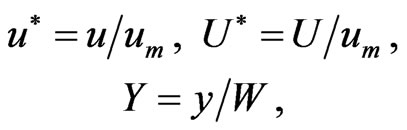 (2)
(2)
the well-known velocity-distribution is [xv],
 , (iii)
where the mean velocity (um) is given by
 (4)
(4)
For the higher up equation, expression for u is obtained by solving the momentum Equation (1).
The energy equation, including the effect of viscous dissipation, is given past
 , (five)
where the 2nd term on the right-mitt side is the viscous-dissipative term. In accordance to the assumption of a thermally fully developed flow with uniformly heated boundary walls, the longitudinal conduction term is neglected in the free energy equation [23]. Post-obit this, the temperature gradient along the axial direction is independent of the transverse direction and given as
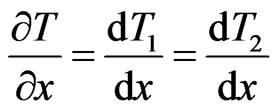 , (half-dozen)
where  and
and  are the upper and lower wall temperatures, respectively.
By taking , introducing the non-dimensional quantity
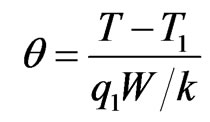 , (7)
, (7)
and defining a dimensionless constant ,
,
 , (viii)
and modified Brinkman number  equally
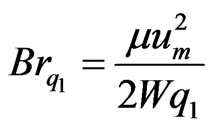 , (9)
, (9)
Equation (5) can be written as
 (10)
(10)
The thermal boundary conditions are
 (11)
(11)
The solution of Equation (10) nether the above thermal boundary weather condition can be obtained as
 (12)
(12)
To evaluate  in the higher up equation, a 3rd boundary condition is required:
 . (13)
By substituting Equation (13) into Equation (12), 
can be expressed equally
 (14)
(14)
Therefore, the solution of Equation (10) under the above thermal purlieus conditions tin be written in a simplified form as
 (fifteen)
where
 (sixteen)
In fully developed flow, information technology is usual to apply the mean fluid-temperature,  , rather than the centerline temperature, when defining the Nusselt number. Thus mean or majority temperature is given past
 , (17)
with  the cross-sectional area of the channel and the denominator on the right-hand side of Equation (17) tin be written every bit
 . (18)
Using Equations (3) and (xv), the numerator of Equation (17) tin can be constitute. Therefore the dimensionless hateful temperature is given by
 . (nineteen)
At this point, the convective heat transfer coefficient can be evaluated by the equation
 . (twenty)
Defining Nusselt number to exist
 , (21)
where Dh is the hydraulic diameter defined by Dh = 2W, the expression for Nusselt number can exist shown to be
 (22)
(22)
When qii = 0,
 (23)
(23)
agreeing with reference [15].
Explicit expressions for Nusselt number for various values of U*,  and
and  are given in the following discussions.
3. Graphical Results and Discussions
For the purpose of discussion on the beliefs of the Couette-Poiseuille menstruum, 2 types of graphs based on the belittling solutions are made. The temperature profile in the aqueduct is plotted with variations of diverse parameters to indicate the heated region, and the Nusselt number is plotted to reveal the rut transfer characteristics of the flow.
3.1. Temperature Profiles against the Channel Width for Diverse Parameters
3.1.1. Temperature Profiles for the Case of Insulated Lower Plate
Effigy 2 shows the dimensionless temperature profiles of  versus Y, where the lower plate is insulated at five dimensionless velocities U* = −1.0, −0.5, 0.0, 0.v and 1.0, and at half-dozen selected
  values from −0.01 to 0.5, as shown in (a) to (f). The temperature distributions have similar pattern but different shapes, and all the curves converge at Y = 1, θ equal to 0, by definition. At Y = 0, the curves are vertical to satisfy the insulated condition. Every bit expected, generally the motion of the upper plate tends to impart more estrus into the fluid layers that are dragged along, unless off-set by the gummy dissipation effects. Information technology is observed that when
  = −0.01, 0.0, 0.01 and 0.ane, the temperature distribution is negative which implies there is decrease in heat transfer, whereas when
  = −0.one and 0.5, θ manifests in a different style such that θ takes both negative and positive values.
3.i.ii. Temperature Profiles for a Fixed Brinkman Number for Various Oestrus Flux Ratios
The issue of pasty dissipation is seen in the value of modified Brinkman number. It is interesting to observe the behavior of the temperature profiles for various oestrus flux ratios for a fixed modified Brinkman number and hence to note the issue of gluey dissipation. In Effigy 3, for a  value of 0.01, the temperature distribution is investigated at U* = −ane.0, −0.5, 0.0, 0.5 and 1.0 for various heat flux ratios. When
 , the values of theta are all negative. For the equal heat fluxes, for U* = −1.0, −0.five and 0.0, theta takes only negative values, just for
 , theta takes both positive too as negative values. When
  and ten.0, theta takes both positive likewise as negative values. For
 , when the upper plate moves in the negative direction with values U* = −1.0, −0.5, theta takes both positive also every bit negative values and when the upper plate is fixed and moves in the positive direction with values U* = 0.5 and 1.0, theta takes positive values. Equally expected over again, all the curves converge at Y = 1.
iii.two. Nusselt Number Variations
Effigy 4 shows the plots of Nusselt number versus the estrus flux ratio  at U* = −1.0, −0.v, 0.0, 0.5 and 1.0 at various
  values. The hyperbolic curves accept asymptotes occurring at different
 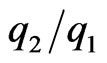 values. It is observed that, for the specified values of
 , when
  = −0.01, 0.0, 0.01 and 0.i, the asymptotes fall to the positive direction of
 , whereas when
 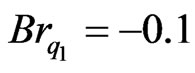 at
at , the asymptote falls at
  and when
 , the asymptote falls at
 , as given in Table 1.
four. Decision
Heat transfer with the consequence of viscid dissipation has been analysed. Analytical expressions for Nusselt number take been obtained for fully developed Newtonian fluid flow between infinitely long parallel plates, where the lower plate is stock-still and the upper plate is moving with constant velocity. When both plates are kept at
different abiding heat fluxes, the dimensionless temperature distribution is given past Equation (15), and the Nusselt number by Equation (22) and they are in terms of ,
,  and Diverse dimensionless velocity values such every bit −i.0, −0.5, 0.0, 0.5, and 1.0, constant heat flux ratios 0, 0.five, 1.0, 2.0, 10.0 and 50.0 and modified Brinkaman numbers −0.01, −0.one, 0.0, 0.01, and one.0 are considered in the analysis. The behaviour of the temperature distribution and the Nusselt number against these parameters are discussed. The Brinkman Number, the speed of the moving plate and different values of heat fluxes at both the plates accept significant impact in the thermal development.
5. Acknowledgements
Role of the results was submitted as a conference paper to the 4th International Meeting of Advances in Thermo Fluids (IMAT2011), Melaka, Malaysia.
dickensoffirest53.blogspot.com
Source: https://www.scirp.org/html/1-2320026_25400.htm
0 Response to "Consider Again Fully Developed Couette Flow Flow Between Two Infinite Parallel"
Post a Comment